Summary
Contents
Summary#
Timeline#
I haven’t copied the timeline into these notes since I don’t have much to add here for the tutorial. Refer to the lecture slides if you need a recap.
Very briefly, the events/eras covered in the timeline are:
The Turing Test (1950)
The Golden Age of AI (1956-1974)
The First AI Winter (1974-1980)
The Knowledge Era (1980-1987)
The Second AI Winter (1987-1993)
The AI Revival (1994-Present)
AI Winters#
Caused by a tendency to overhype recent developments and overestimate the impact they will have on society.
We tend to overestimate the effect of a technology in the short run and underestimate the effect in the long run.
—Amara’s Law
AI has failed to live up to hype for various reasons, including:
an inability to scale up ideas that work in small-scale tests,
limitations of the models available at the time,
Moravec’s paradox
the observation that, contrary to what was traditionally believed, reasoning requires relatively little computation, but sensing, perception, and recreating motor skills require large amounts of computation
the qualification problem
the impossibility of listing all the preconditions required for a real-world action to have its intended effect
History and Representation#
Research in AI, including ethics, has been driven mostly by males from western societies (take the “Founding Fathers of AI” who attended the Dartmouth Conference for example).

Diversity is recognised as being important, but people from non-Western backgrounds and of non-male genders are still marginalised and under-represented. Males are still represented at a vastly higher rate than other genders according to research conducted by Marc and Simon in 2021:
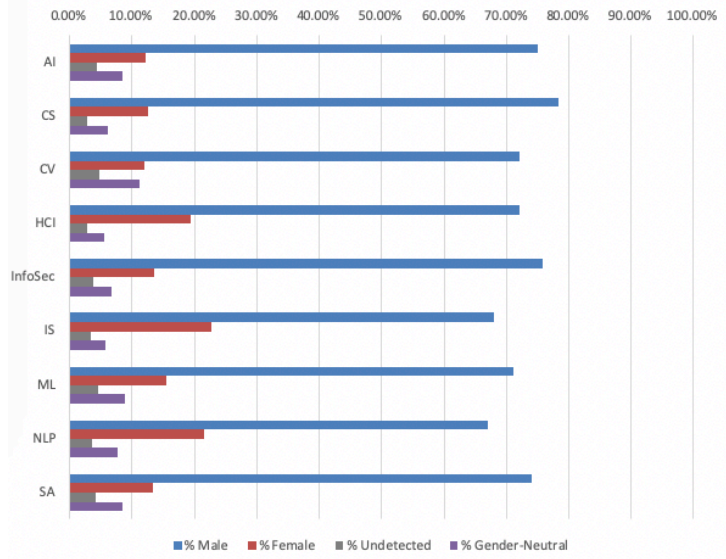
Fig. 5 Gender distribution of authors by CS subfield, including gender-neutral names and undetected names. Source: Computer Science Communities: Who is Speaking, and Who is Listening to the Women? Using an Ethics of Care to Promote Diverse Voices#
Effects of Under-representation#
A lack of diversity and representation can result in a lack of:
privacy
fairness
accessibility & inclusion
safety
transparency
functionality
Types of Diversity#
When forming teams to work on problems in AI (and other domains) we should seek diversity in areas such as:
gender
culture
ethnicity
sexual orientation
disability
family status
age
class
education
and more!